For many people, the pathway into child sexual abuse material (CSAM) offending begins in everyday online environments. Search engines were the first place where warning messages were deployed at scale, appearing on Google and Bing in 2013. Warning messages for CSAM related queries on search engines are now required or recommended in Australia and the United Kingdom.
Following their deployment, the first public robust evidence for the behavioural impact of such messages came from controlled experiments (see the Randomised Controlled Trials case study). However, this has changed, with the publication of two new large real-world evaluations of CSAM deterrence messaging in 2026, to add to the first real-world evaluation from 2024: one on Google Search, the world’s most used search engine, and one on Ahmia.fi, the most used search engine on the dark web.
This case study will give a brief overview of these two new evaluations and briefly touch on an update on Microsoft Bing’s warning message that occurred in 2026 in Australia as well.
This work, collectively, shows that warning messages deter CSAM searching, and well-designed messages redirect large numbers of people with help. The works draw attention to the need to take warning messages beyond search, into the many other online platforms where offending pathways begin.
Google Search: Redesigning the Onebox

In March 2024, Google convened a participatory design workshop with ten international experts in deterrence and in therapeutic intervention for people with a sexual interest in children.
The existing Onebox had emphasised the illegality of CSAM and how to report it. The redesigned Onebox instead leads with the consequences of continued searching and with signposting to support services. This placed anonymous self-help and helpline services first, ahead of victim-support and reporting options.
The new Onebox launched on 12 February 2025 in eleven regions with established anonymous help services (including Australia), with a second wave of more modest updates in ten further countries. In the six months to January 2025, the Onebox was triggered by an average of 20 million CSAM-seeking queries every month across these 21 regions.
The evaluation, released in June 2026, used a difference-in-differences design to measure impact. It compared nearly 700,000 sessions containing a warning in countries with the Onebox, with 372,000 sessions in five comparison countries without the Onebox. The results were:
- The share of users who went on to issue another CSAM-related query in the same session fell by 3.8 percentage points relative to comparison countries. A robustness analysis restricted to European countries found a 5.6 percentage point reduction.
- 0.73% of warned sessions clicked through to a help service. In the United Kingdom, the click-through rate more than tripled after launch, from 0.5% to 1.7%.
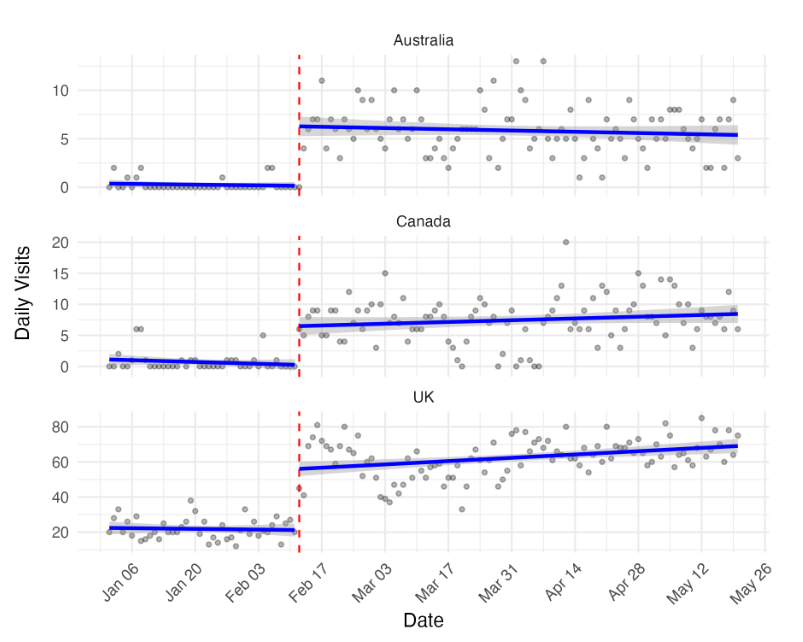
- Independent website traffic data from the help services themselves confirmed the effect: every service with available data recorded an immediate, statistically significant increase in daily visitors.
Ahmia.fi: Message content matters
Warnings can deter CSAM searches on the open web, but the dark web is a different environment: users are anonymous, expect impunity, and are often further along an offending pathway. Protect Children (a Finnish child protection organisation) ran a 140-day field experiment on Ahmia.fi, a search engine for the Tor network.
Over the study period, Ahmia processed almost 20 million searches, of which 3.1 million (15.8%) matched a list of 1,281 banned CSAM-related terms, around 22,000 every day. Each triggered a warning in place of results, linking the searcher to ReDirection, Protect Children’s anonymous self-help program.
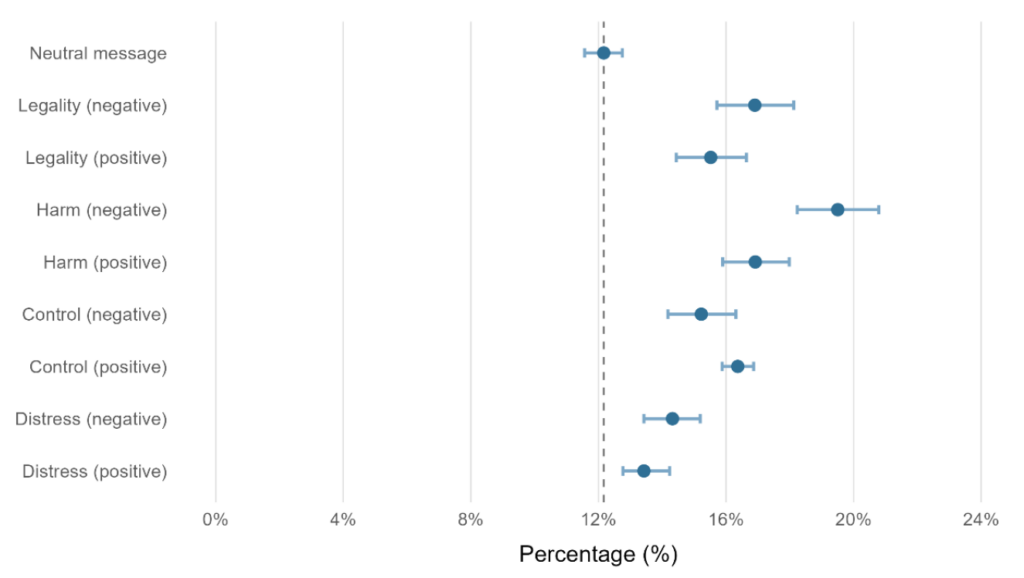
During the 70-day campaign phase, eight warning message variants were rotated and compared against a neutral control. The messages drew on four themes: legal and personal consequences of offending, harm done to victims, capacity to change, and psychological distress associated with CSAM use. Each had negative and positive framings. Every one of the eight messages outperformed the neutral control, and a message focused on the harm caused to victims performed strongest.
The redesign transformed engagement with the warning messages on Ahmia. The click-through rate to support resources rose from 8.73% before the campaign to 15.67% during it, with the odds of a warned user engaging with help doubled (OR 2.01). Across the study, warnings generated 386,497 clicks to help, roughly one for every eight warnings shown.
Notably, message content made no measurable difference to the number of banned searches conducted; its influence was in converting the moment of interruption into engagement with support. However, like open web search providers, a warning message has been in place on the search engine for multiple years, and has already suppressed the search volume for CSAM by 57.7% – a result that also likely reflects an existing depressive effect on search on Google and Bing.
Protect Children surveyed more than 6,000 people searching for CSAM following the experiment, and three in four said a warning message had prompted them to reflect on or change their behaviour.
Microsoft Bing: Collaboration and Evidence

Microsoft’s Bing has displayed warnings against CSAM searches since 2013. During early 2026 Microsoft worked with the team at the CSAM Deterrence Centre to update the warning message within Australia, and how the reporting options were presented to users.
While this did increase referrals, this also occurred within weeks of the nationwide launch of the Stop It Now! Australia helpline, so an evaluation covering that period is not possible due to the change in referrals already occurring. However, the Microsoft lead on digital safety in Australia & Asia said the following about the redesign process of updating the warning message on Bing.
“Language matters deeply in CSAM deterrence. The goal isn’t simply to tell people not to engage in harmful behaviour, but to reach them in a way that encourages reflection and supports help-seeking before harm occurs. We’re grateful for the CSAM Deterrence Centre’s guidance to get our language right. Their expertise helps ensure messaging is grounded in evidence, resonates with the intended audience, and has the best chance of redirecting individuals towards support and away from behaviours that put children at risk.”
Madeline Shepherd (Director, Digital Safety – Asia)
Key takeaways
- Warning messages have earned a place in the core of CSAM prevention: They now stand proven at scale on the world’s most used search engine and in one of the most anonymous corners of the internet. They deter further searching and generate hundreds of thousands of referrals to help line services.
- Content and design are not cosmetic: On Ahmia.fi, redesigned messaging doubled engagement with help. On Google Search in the UK, the click-through rate tripled. What a message states, and how simply and prominently it presents the path to support, determines what it achieves.
- Build evaluation in and keep evaluating: The strongest evidence has come from deployments that were set up for measurement from day one. Effectiveness should be monitored continuously, not assumed.
- Refresh messages to counter habituation: Static warnings appear to lose impact as the same users encounter them repeatedly. Regularly rotating and optimising message content keeps warnings salient.
- Search is only one environment: CSAM is sought and shared in many online contexts including social media, file-sharing and storage services, adult-content platforms, and messaging, including high-privacy and end-to-end encrypted environments. The evidence from search now justifies deployment of warnings wherever those pathways exist.
For more information on the broader evidence base and how warning messages should be designed, check out our best-practice guide.